
![[Book #36321] Witness: From the Shah to the Secret Arms Deal.; An Insider's Account of U.S. Involvement in Iran. Mansur Rafizadeh.](https://groundzerobooksltd.cdn.bibliopolis.com/pictures/36321.jpg?width=768&height=1000&fit=bounds&auto=webp&v=1295621725)
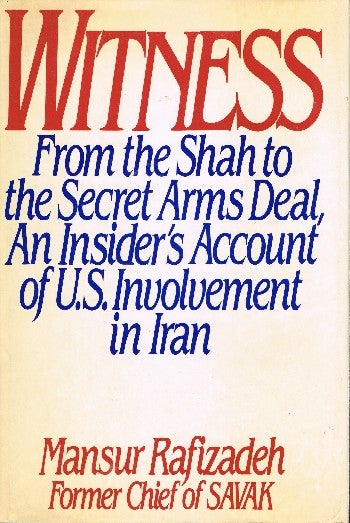
Witness: From the Shah to the Secret Arms Deal.; An Insider's Account of U.S. Involvement in Iran
New York: William Morrow and Company, Inc., 1987. First Edition [Stated], First Printing [Stated]. Hardcover. viii, 396 pages. Illustrations. Notes., DJ has some wear and soiling. Ink notation on the fep. The behind-the-scenes, insider's account of the Iranian arms scandal, revealing startling new facts about the deal and those in government who knew of it as early as 1981. The author, who was the former chief of the Iranian secret police and a covert mole for the CIA, also details life in Iran before and during the Shah. Mansur Rafizadeh (14 December 1930, Kerman, Iran - 8 February 2018, Middletown, New York) was an Iranian-born intelligence expert who worked for multiple intelligence agencies and, in 1987, wrote an exposé, Witness: From the Shah to the Secret Arms Deal, An Insider's Account of U.S. Involvement in Iran, for which he is best known. He worked for the Iranian Pahlavi dynasty during the 1970s and, he claimed, for the CIA into the early 1980s. Disillusioned with the monarchy of the Shah and his excesses, Rafizadeh became a double-agent for the CIA during the Carter/Reagan years. He also worked in New York City at the Iranian Mission to the United Nations. After the Iranian Revolution in 1979, diplomats with the Islamic Republic of Iran stated that he was an agent of SAVAK (the Shah's secret police) in the U.S., a claim he denied at the time. Years later, he confirmed the claim. He claims to have been the U.S. director for SAVAK. Witness: From the Shah to the Secret Arms Deal (1987) by Mansur Rafizadeh is an insider memoir detailing the author's role as the U.S. director of SAVAK, the Shah of Iran’s intelligence agency, while also acting as a covert CIA source. The book offers an account of Iranian politics and U.S.-Iran relations, though specific text from a Kirkus review was not found in the search results. Rafizadeh, was educated at Tehran University and later in the US (Harvard/NYU). He claimed a dual role as a high-ranking intelligence officer for the Shah and a source for the CIA. This work focuses on American involvement in Iran from the 1950s through the 1979 Revolution. The Bureau for Intelligence and Security of the State (shortened to SAVAK) was the secret police of the Imperial State of Iran. It was established in Tehran in 1957 by national security law, and continued to operate until the Iranian Revolution in 1979, when it was dissolved by Iranian prime minister Shapour Bakhtiar. The French intelligence service, the Service de Documentation Extérieure et de Contre-Espionnage (SDECE, predecessor of today’s DGSE), assisted in establishing and training SAVAK during its formative years in the mid-1950s and early 1960s. French instructors provided courses in surveillance, counter-subversion, interrogation techniques, and political intelligence gathering—expertise refined during the Algerian War. According to a declassified CIA memo citing a classified U.S. Senate Foreign Relations Committee report, the CIA played a significant role in establishing SAVAK, providing both funding and training. The organization became notorious for its extensive surveillance, repression, and torture of political dissidents. The Shah used SAVAK to arrest, imprison, exile, and torture his opponents, leading to widespread public resentment. This discontent was leveraged by Ayatollah Ruhollah Khomeini, then in exile, to build popular support for his Islamic philosophy. At its peak, SAVAK reportedly employed approximately 5,000 agents operating under the Pahlavi dynasty. Iranian-American scholar and ex-politician Gholam Reza Afkhami estimates that SAVAK had between 4,000 and 6,000 members, while TIME stated in a publication on 19 February 1979 that the agency had 5,000 members. Condition: Very good / Good.
Keywords: Shah of Iran, Iran-Contra, Khomeini, Pahlavi, CIA, Foreign Relations, Hostages, SAVAK, Kerman, Tehran, Exiles, Political Prisoners, Ashraf, Baghai, Oveissi
ISBN: 0688073697
[Book #36321]
Price: $42.50